
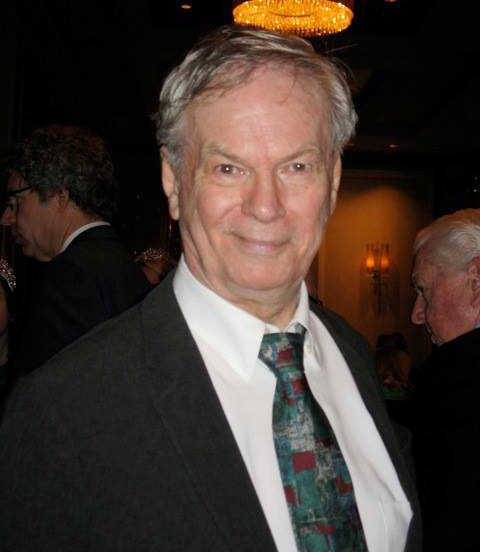
Alan Hustak remembered for preserving history and pursuing truth
The death of veteran journalist and historian Alan Hustak has left a void across Saskatchewan and beyond, with friends, colleagues, politicians and community leaders remembering a man whose curiosity, encyclopedic memory and fierce dedication to storytelling shaped generations of readers and preserved the history of Fort Qu’Appelle and area.
Hustak, whose decades-long journalism career included work with Grasslands News, the Montreal Gazette, CBC and CTV, died just before a major museum event he had helped organize in Fort Qu’Appelle — a community he never stopped championing despite years spent covering national and international stories.
A lifelong friend
Longtime friend Bonnie Schaffer said she first met Hustak in 1958 when they sang from the Sound of Music songbook together on a local CKCK television program.
“We sang ‘You Are 16 Going on 17,’” Schaffer recalled with a laugh, adding Hustak would still sing the song to her decades later whenever they met again. “And he had a great singing voice.”
Schaffer remembered Hustak as charismatic and stylish in his youth.
“He was handsome,” she said. “He went to Campion College, and they wore uniforms – which he pretty much wore till he died, some variation of the same outfit.”
Schaffer said Hustak possessed uncanny instincts as a journalist.
“I don’t know how or who hired him first, CBC or CTV, but the next thing I know he’s on CTV in Alberta and he’s written the book, like ‘the Bible’ about Peter Lougheed, and then the Titanic book, and then he’s at the Montreal Gazette,” she said.
She later visited him in Montreal while her son attended McGill University.
“He was this man about town when he was with the Gazette,” she said. “He knew everybody.”
Though she acknowledged Hustak could sometimes be difficult, Schaffer said his complexity made him memorable.
“He was kind, he was brilliant, he was generous, he was pompous, he was ridiculous,” Schaffer said. “He knew everybody – he knew Mulroney, he wrote the book on Justin Trudeau – he had all these incarnations. We were great friends. But you will, I’m sure, talk to somebody who met him once or twice and felt the same way. Historically, he was brilliant. And you know, he worked so hard at the museum. They were so lucky to have him.”
“He just had this big, big life,” she continued. “I loved his opinion columns in The Times, I think he increased circulation of the Fort Qu’Appelle Times like a gazillion per cent!”
She said people often underestimated how deeply he cared for others.
“He gave great presents,” Schaffer said. “Lovely. Thoughtful.”
She also reflected on Hustak’s devotion to his mother, whom he cared for as her health declined.
“He loved his mother,” she said. “He protected her and looked after her very well,” recalling how Hustak once took his mother aboard the Queen Mary to sail to London.
Schaffer said Hustak viewed journalism as both responsibility and education.
Messages of condolence also arrived from outside Saskatchewan.
Douglas Leahey of Montreal’s St. Patrick Development Foundation said Hustak served for years on the organization’s board of directors.
“He was mostly involved in our marketing and writing our newsletter,” Leahey wrote.
Leahey said Hustak continued visiting Montreal regularly around St. Patrick’s Day.
“He obviously made an impression in Fort Qu’Appelle as he did here in Montreal,” he wrote.
Friends say Hustak’s influence extended far beyond headlines and bylines.
He nurtured artists, mentored young politicians, preserved prairie history and connected communities through storytelling.
A passion for history
For artist and musician Brian Baggett, the friendship that developed between the two men was unexpected.
“Alan and I were the most unlikely pairing of friends,” Baggett said.
Their friendship began after Hustak photographed one of Baggett’s concerts in Fort Qu’Appelle, but it deepened years later over a shared fascination with prairie history.
“It had nothing to do with journalism, it had nothing to do with my art,” Baggett said. “It was over historical finds – like landmarks, old stone houses, buildings, whatever remote cemetery out in the middle of nowhere.”
Baggett said Hustak became both mentor and guide for these excursions through local history.
“Alan is truly the master in that realm and I became the protege,” he said.
The pair spent years exploring Saskatchewan’s back roads, cemeteries and abandoned stone houses. Baggett said many of his cycling adventures during the pandemic were inspired by places Hustak had mentioned in conversation.
“Because of Alan, I got interested in these physical historic locations whether it be a building or just a landmark of some sort,” Baggett said, noting Hustak delighted in uncovering forgotten stories but also enjoyed being challenged.
“My favourite game was ‘Stump Alan,’” he said. “I think three times I can think of – maybe five – that I found something that Alan didn’t know about. Then he would go out and use his journalistic magic to find the backstory on it.”
The journalist’s determination also became legendary among friends.
Baggett recalled a train derailment near Edgeley where authorities had tightly restricted access.
“Alan found a way because the train had derailed where the track goes through some guy’s land and he just happened to know the farmer,” Baggett said. “I’m trying to picture this 70-something, 80-year-old guy in a four-door sedan driving through a field to go get the scoop – and he was the only one that got photos of it!”
“He hobnobbed with every prime minister between both Trudeaus, he met British royalty, many actors like Christopher Plummer – he’s known them all,” continued Baggett.
Despite his accomplishments, friends repeatedly described Hustak as humble and generous.
“A few years ago, he was pulled over by a cop because he was driving erratically,” Baggett recalled. This prompted Hustak to visit a doctor, where a previously unknown heart issue was discovered. After recovering, Hustak drove back to thank the RCMP member who pulled him over.
“He’s like, ‘You saved my life, thank you,’” Baggett said. “He was very generous, humble.”
Always in the community
Local politics was also of strong interest for Hustak. Fort Qu’Appelle Mayor Brian Strong said his presence at council meetings and community events became part of the town’s fabric.
“He was always at our meetings, well informed,” Strong said. “Anything that he needed, he received.”
Strong described Hustak as a passionate community advocate whose knowledge of local history was unmatched.
“The knowledge of the museum, the McDonald House, the history that he had ‘upstairs’ — I don’t think any one of us has that kind of history,” he said.
Strong said Council occasionally sought Hustak’s opinion directly during meetings.
“We’d get him up out of his chair and say, ‘Alan, what do you think about this?’” Strong said. “At times we disagreed, but that’s what sold your papers!”
The mayor said it was heartbreaking that Hustak died just before the dedication event at the McDonald House museum project, which he had worked tirelessly to support.
“Today would have been his day,” Strong said. “His presence here would have been blessed.”
At the Fort Qu’Appelle Museum, executive member Doug Porcina said Hustak was instrumental in transforming the organization into a growing heritage institution.
“He was the push,” Porcina said. “He was also the inspiration.”
Porcina said Hustak helped drive the museum toward charitable status, grant applications and expansion plans.
“One of the most recent things we did was the First Nations Garden, collaboration between First Nations people and us,” Porcina said.
The museum’s work, he added, reflected Hustak’s passion for bringing people together around shared history.
“He was doing conventions and things with like-minded people,” Porcina said. “As you know, as a reporter, he has done that in spades.”
Leanne Redman, a member of Standing Buffalo Dakota Nation and active community volunteer, remembered Hustak’s enthusiasm for local arts and Indigenous history.
“He was always involved in things that I kind of had interest in — museum pieces, First Nation things, histories,” Redman said.
She first met him during a library exhibit featuring Indigenous artifacts.
“He brought in a beautiful wall hanging from his travels,” she said. “And he was just so excited that something was happening in the library.”
Redman said Hustak’s encouragement helped foster wider community collaboration.
“It actually started a collaboration,” she said. “The museum got involved.”
She described him as someone constantly present at community events.
“He was at the Women of Distinction Awards last year in his Alan way and with his reporter badge on,” she said with a laugh.
Redman said Hustak’s commitment to preserving local history will have lasting impacts.
“I’m really going to miss seeing him and his knowledge that he had of the area,” she said.
She believes his legacy deserves a permanent tribute.
“I would like probably to see a road or something named after him,” Redman said. “A flower bed or some section up here with him in it because he did like his gardens.”
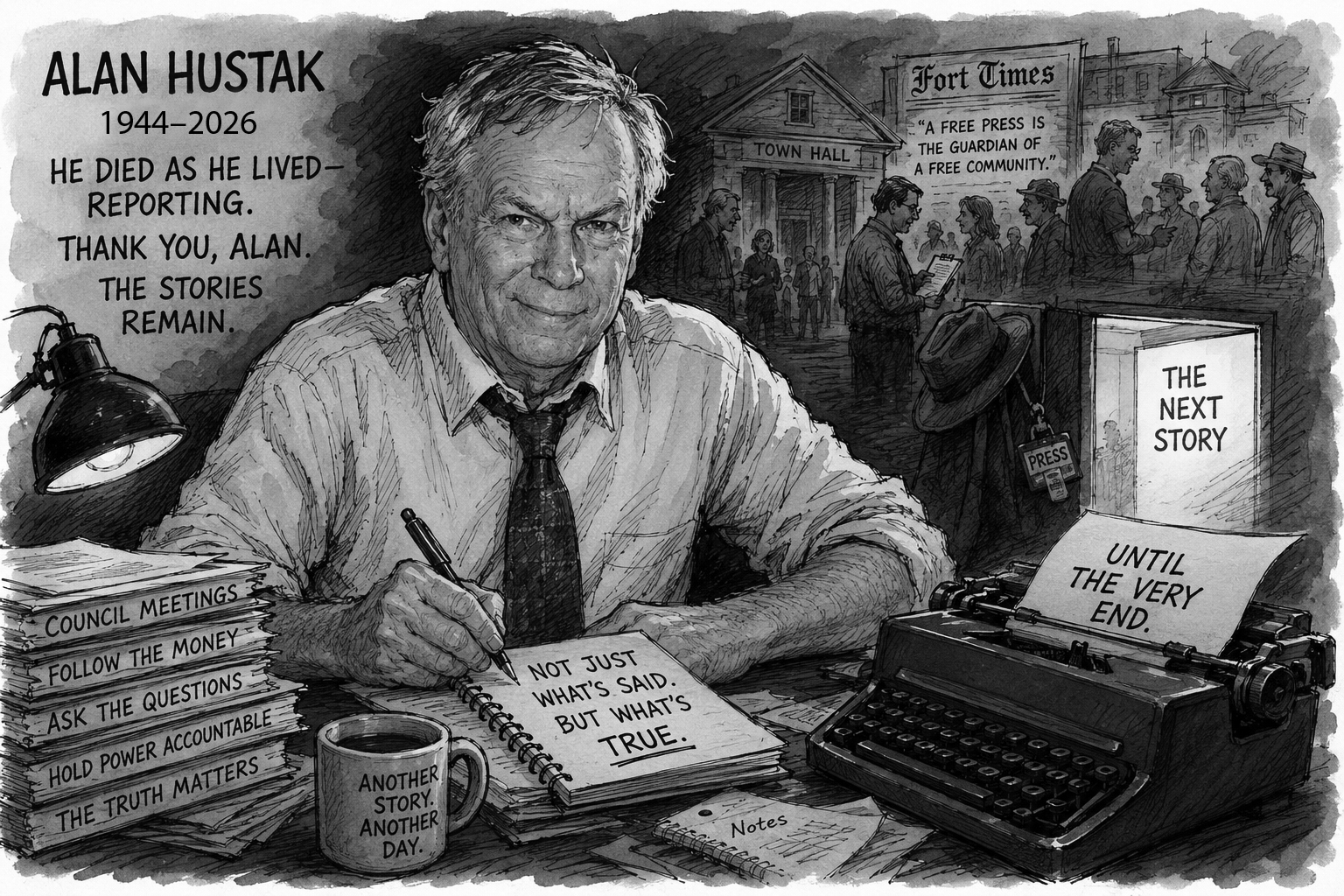 Remembered far and wide
Last Mountain-Touchwood MLA Travis Keisig said Hustak conducted his first-ever media interview after winning the party nomination in 2019.
“He drove out to my farm and did an interview,” Keisig said. “I will always remember him for that.”
Keisig described Hustak’s reporting style as balanced and thoughtful.
“His articles were very well written, extremely well read,” he said.
Keisig also admired Hustak’s historical knowledge and breadth of experience.
“I loved his stories of him interviewing John Diefenbaker and Pierre Trudeau,” he said. “He lived a long and full life and his historical knowledge was second to none.”
White City-Qu’Appelle MLA Brad Crassweller said one of his regrets is never sitting down with Hustak simply to hear stories from his life.
“He had quite a political journey that I really didn’t know much about,” Crassweller said, adding Hustak’s personality immediately stood out when they first met.
“He’s a character!” he said, describing Hustak as direct but deeply authentic.
“He would set you straight if he felt he had to and ask you point-blank questions,” Crassweller said, adding Hustak’s national-level accomplishments never changed him.
“He was very down-to-earth,” Crassweller said. “An absolute icon in that realm.”
Veteran CTV broadcaster Wayne Mantyka said he had known Hustak since the mid-1970s.
“To have been the national reporter for the region back then, there were only a handful,” Mantyka said. “That spoke to his abilities and accomplishments.”
Despite eventually working in Montreal and covering national politics, Mantyka said Hustak never lost his connection to Saskatchewan.
“He never forgot where he came from,” Mantyka said. “The region was quite lucky to have some of that experience working here.”
For those who knew Hustak, that spirit of restless curiosity defined him until the end.
And in Fort Qu’Appelle, many say his stories will continue long after his death.
—-
Those wishing to share their memories of Alan Hustak can send them to Grasslands News here.