
Editor’s Note: The following is the complete four part series of a investigative report by Grasslands News reporter Connie Schwalm into the Humboldt Broncos’ tragic bus accident and the aftermath.
What the screens never revealed
They manifest inside whatever screens we allow in our lives.
We may try not to look at them.
But we see them.
They are images of tragedy, loss, heartbreak.
They are photos of the worst moments in someone’s life.
You may well have seen many such images.
Yet, the photo on this page is one you might recognize.
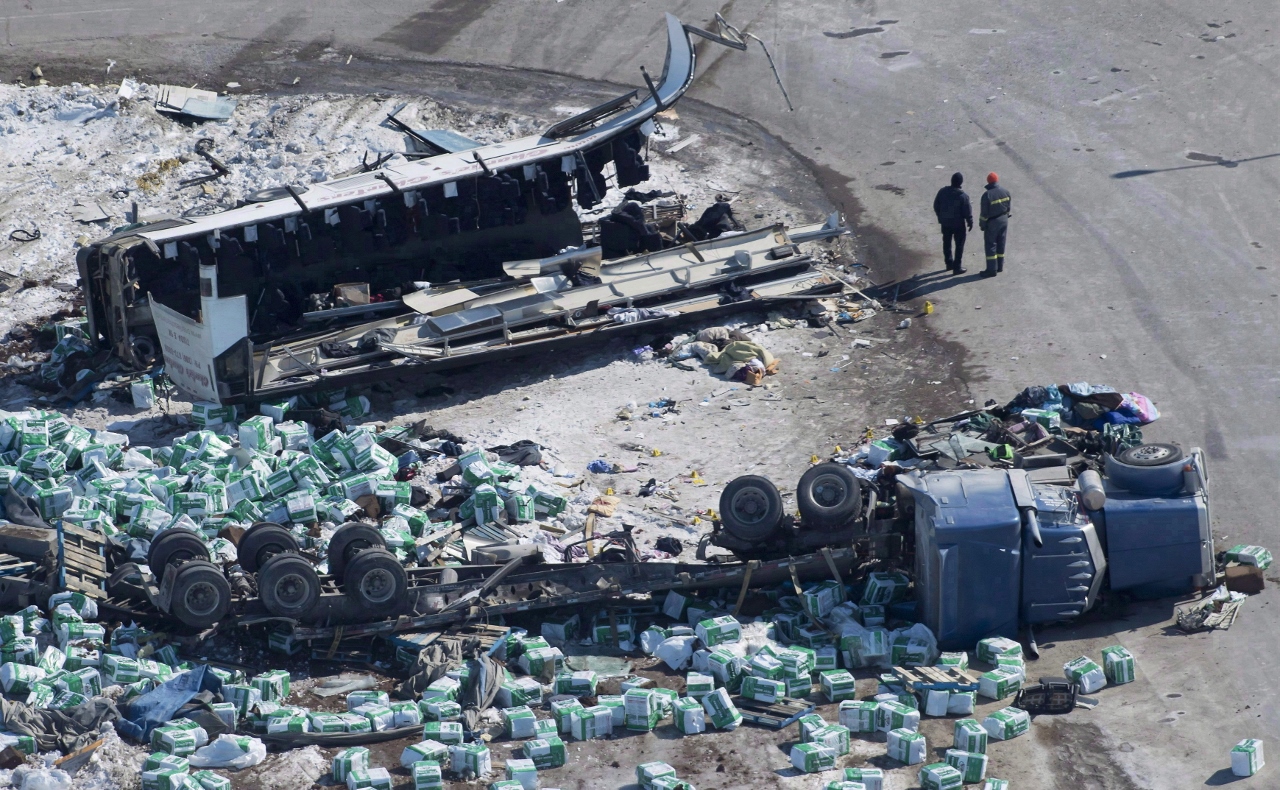
It is an aerial photo depicting the Humboldt Broncos Bus Crash
You would have first seen this photo, or one much like it, eight years ago.
At that time, the story of what had happened to 29 people who had been on the Humboldt Broncos team bus and the incomprehensible grief and loss that had descended without warning into the lives of everyone who loved them, transcended borders between provinces and countries.
In the aftermath of the crash there was special coverage, in-depth analysis and exclusive interviews as news outlets across Canada offered up “heart-wrenching” details of what had become a major story.
Almost every segment featured a photo like this.
Look closely at the image on this page.
What do you see?
There is what used to be a bus, lying on its side and ripped to shreds, roof severed from the frame. A more recognizable Peterbilt semi-trailer truck is also lying on its side, trailers twisted, bales of peat moss strewn across the scene. It graphically depicts the destruction that occurred when the bus exploded against the side of the super B trailers.
Yet as detailed as the photo is, there is so much you can’t see.
You don’t see the Kenworth and its payload suddenly appearing in front of the bus.
You can’t see the face of Glen Doerkson, the bus driver, as he desperately slammed his foot down on the brake, nor see the bus skid for 24 metres before it exploded against the trailers.
You can’t see the kids thrown from their seats at highway speed against frozen, unforgiving dirt. There is no trace of them, no way to see what that does to flesh, blood and bone.
You don’t see those who were lodged underneath what was left of that bus, as rescuers walked on top of it, trying to reach those who might still be saved.
We say that images are worth a multitude of words.
But as many words as this photo might be worth, it is silent where it matters most.
Some were there to bear witness.
There were the dedicated first responders at the scene.
They were rarely featured in media reports.
It was too difficult for them to talk about what they had witnessed.
Those of us who are volunteer firefighters or first responders and have been at the scene of motor vehicle accidents, might be far too able to envision what they saw.
There were parents at the scene.
Most were held back at a distance by police, but there had been parents following the bus. Nobody had been there to pull them back.
No matter where they stood, none of those parents can ever forget what they saw, or the agonized cries that they heard.
People heard and saw the stories that were told in the media reports and were shocked…saddened…horrified. They listened as each new facet of the tragedy was outlined in the latest reports and shook their heads. It was incomprehensible.
That 13 healthy young athletes had been left dealing with injuries that forever changed their lives – that 16 more were dead – was something that many found overwhelming. Hockey parents imagined how they would feel if it had been their children on that bus. Simply the thought of it was more than many could bear.
Many across Canada sincerely grieved for the families and reached out in whatever way they could to offer comfort.
Yet for most of us, the Humboldt Broncos Bus Crash is something we remember once a year. Some of the memorials and tributes have become annual observances, as people in hockey rinks, at community gatherings or in their homes, make time to honour the Humboldt Broncos.
We can remember, then walk away, back into our lives.
The families of those 29 people cannot do that.
And an empty, persistent silence was left behind by the sixteen people who were killed.
Those who loved them cannot escape it. Part of them died in the shadow of that shattered bus. That silence has become an irrevocable part of their everyday lives, a hollow, familiar ache.
Adam Herold was 16 years old – the youngest person killed in the crash.
One year after the crash Global News spoke to Adam’s parents.
(Here without you: Life one year after the Humbolt Broncos tragedy – April 7, 2019)
“There’s always that empty chair,” Russell (Adam’s dad) said in that interview. “There’s always that spot in the vehicle where he’s not there.”
As the investigation into the crash was launched, the question so many were asking was “How did this happen?”
When the RCMP concluded their three-month investigation, the truck driver, Jaskirat Singh Sidhu was arrested and charged with 16 counts of dangerous driving causing death, and 13 counts of dangerous driving causing bodily harm.
Russell had hoped the criminal justice system would provide answers.
But for him, the question was not ‘How did this happen?’
The question that Russell and the other families were asking was:
“Why did this happen?”
“We wanted justice,” Russell says.
“And we wanted to know why – why didn’t Sidhu stop?”
At the beginning of what should have been his trial on January 8, 2019, Sidhu stood up in the courtroom and said, “I plead guilty, your honour.”
Those were the only words he spoke.
Sidhu’s lawyer Mark Brayford maintained that Sidhu’s decision to plead guilty to all charges was prompted by the desire to spare his victims’ families the pain of a trial.
“Mr. Sidhu advised me: ‘I don’t want to make things any worse. I can’t make things any better, but I certainly don’t want to make them worse by having a trial,”’ Brayford was quoted as saying.
(I don’t want a trial:’ Truck driver in Humboldt Broncos crash pleads guilty By: Ryan McKenna – The Canadian Press – Published: Jan. 8, 2019)
But Sidhu’s guilty plea also meant that he would not face questions about his actions that day. All the evidence that the RCMP had collected through their investigation was not made known. Witness testimony was not heard. And although they would give victim impact statements, there would be no opportunity for the families to ask questions at the sentencing hearing.
More than 90 victim impact statements were presented to the court by friends and families of victims during that sentencing hearing, which began on Monday, Jan. 28, 2019.
In response, Sidhu expressed his remorse to his victims’ families.
“I take full responsibility for what has happened. It happened because of my lack of experience. I can’t imagine what you are going through, what you’ve been through. I have taken the most valuable things of your life. I will be so, so, so, so, so sorry from this day,” Sidhu was quoted as saying.
(I have taken the most valuable things of your life’: Driver in Humboldt Broncos bus crash tells hearing Jason Warick · CBC News · Posted: Jan. 31, 2019
Crown Prosecutor Thomas Healey argued for a 10-year sentence, maintained that Sidhu had not simply made a mistake. He pointed out that Sidhu had driven past four signs indicating an intersection with a stop sign was ahead before coming to an oversized stop sign with a flashing red light above it.
As had been stated in the agreed upon facts submitted to the court, Sidhu had not stopped nor attempted to stop. He instead drove past that oversized, four-foot stop sign with a flashing red light above it at a speed of 86 to 96 kilometres per hour.
Judge Inez Cardinal handed down the sentence on March 22, 2019.
In her analysis, Judge Cardinal stated that:
“It is baffling, and incomprehensible, that a professional driver, even one with little experience, could miss so many markers over such a long distance. His inattention displays risky behaviour given he saw the signs, but they did not register because he continued to focus on the trailers behind him.”
“The semi-tractor unit with its ‘Super B’ configuration was a huge, heavy, and deadly vehicle. It was made even more so by an inexperienced operator in unfamiliar territory who was not giving his full attention to the road ahead of him. He continued past the stop sign without any attempt at braking or evasive action. His large unit straddled both lanes of the highway and left no avenue of escape for the bus.”
The eight-year sentence was the largest one ever handed down in Canada for dangerous driving causing death and dangerous driving causing bodily harm.
When he finished serving his sentence, it was assumed that Sidhu would be deported back to India.
For Russell Herold this was not justice.
He still did not have an answer to that question – Why did this happen?
But Russell is a farmer.
Farmers are accustomed to finding answers on their own and they are willing to put in all the work and sacrifice it might take to do that. And Russell was also determined to discover what could be done to keep something like this from happening again.
So, on July 9, 2018 – one day before Sidhu’s first court appearance following his arrest – a Statement of Claim had been made on behalf of Adam Herold’s family that launched a civil court action. Sidhu was one of the defendants named along with the trucking company that had employed him for only three weeks at the time of the crash.
Russell says that the goal when he launched the lawsuit was to bring about accountability and change.
“We wanted accountability from Sidhu and the company he was working for,” he explains. “You see situations on the highway with poor drivers and that sort of thing. So, we wanted justice, and we wanted accountability because it seemed that this guy wasn’t qualified to be driving. We wanted to see change and we wanted there to be some incentive for change to happen. We didn’t want to see other people going through the same thing we were.”
As far as the criminal justice system was concerned, the case was closed.
Most of the world believed this “sad chapter” was over.
But the civil court action continued to move forward.
On March 18, 2020, the parents of three more of the deceased hockey players – Jaxon Joseph, Logan Hunter, and Jacob Leicht – and the parents of assistant coach Mark Cross were added as plaintiffs and joined the Herold family in their legal action.
For the Herold family and these other families who had buried sons, this was the start of their battle to have their questions answered, spur on whatever changes were needed to prevent such a thing from happening again and find justice for their boys and themselves.
At that same time, another defendant was added.
This defendant had never been featured in an interview, no in-depth report was done.
No media spotlight revealed their presence.
Yet next week, Russell Herold and his lawyers, Kevin Mellor and Sharon Fox will bring forward their arguments outlining why they contend that this alleged third defendant also bears a particular responsibility for that crash.
Return to Armley Corner
There are places in Saskatchewan that are defined and known by their past.
One intersection where two prairie highways cross is just such a place. It is known by those who live in the area as Armley Corner, named after a nearby community that has dwindled down into little more than a memory.
But Armley Corner is better known by people throughout the province and beyond as the site of the Humboldt Broncos’ bus crash.
Russell Herold’s son, Adam was the youngest of the 16 people killed that day. Three months later, in July of 2018, the Herold family launched a civil lawsuit against those they deemed responsible for the crash.
Defendants initially named in that lawsuit included Jaskirat Singh Sidhu, the truck driver involved in the crash, as well as the Calgary-based trucking company that had employed him.
Herold and his lawyers, Kevin Mellor and Sharon Fox, allege that Armley Corner itself was a major factor in the crash, because adequate measures were not taken to address a potentially lethal situation which had existed there for years.
Six crosses were already standing at the intersection on April 6, 2018, the day of the Humboldt Broncos bus crash. They were a memorial for Rod Fiddler, his wife Terri Lynne, their three children (Jocelyn, Jasmine, and baby Kassandre), and Rod’s sister, Wendy Lou Fiddler.
All six were killed on June 17, 1997. The family had been travelling east along the #335 Highway when they came to Armley Corner and failed to stop at the stop sign. Their pickup collided with a southbound semi and subsequently burst into flames.
At that time, Armley Corner was already known as a dangerous intersection. A Collision Reconstruction Investigation Report done by CST. J. Stevenson of the Nipawin RCMP Detachment, following the 1997 crash, contained a reference to the common concerns locals had about the intersection.
“Persons who work at the confectionery store and Cargill Elevator advised that vehicles driven through the intersection at highway speeds are a daily occurrence. This would lead to the credence that there is a problem with the intersection in the way it exists now. Other persons approached the writer requesting information on who to contact to have improvements made to the intersection, as they had seen vehicles come through on numerous occasions.”
The Stevenson Report provided an analysis of the crash and the intersection itself and recommended several measures that could be taken to improve safety there. Among the factors examined in the report were the sightlines that existed at the intersection, and Fox notes that sightlines from several perspectives were considered.
“In the 1997 accident reconstruction report, Stevenson was looking at the sightlines for that accident specifically. The vehicles involved in the 1997 crash had been travelling east and south. So, when Stevenson did the accident reconstruction report and looked at the intersection, he looked at the sightlines as they existed in 1997 from those perspectives. But he also went further and looked at the sightlines from the perspectives of a westbound and northbound vehicle.”
In the Stevenson Report, it states:
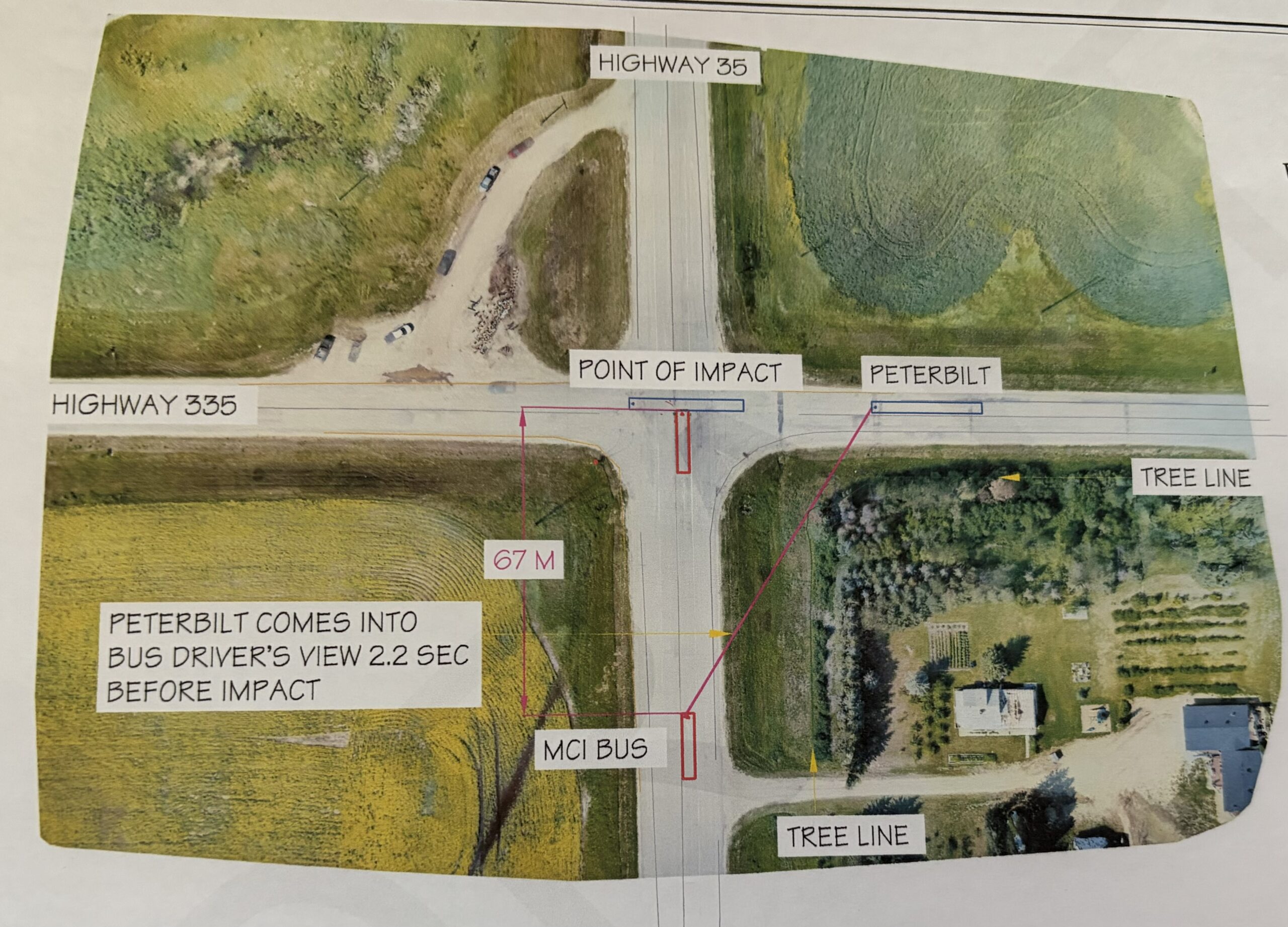
View Obstructions/Restrictions – Westbound #335 traffic/Northbound #35 traffic: “View obstructions/restrictions in the form of a long row of trees were noted for westbound traffic travelling on #335 highway towards the intersection. As a vehicle approached the intersection with #35 highway, approximately 400 m E. visibility towards the south was prohibited until the vehicle was 20 m E of the intersection. At that point, a northbound vehicle on # 35 highway could be seen. Likewise, a northbound vehicle on # 35 highway approaching the intersection had the same view obstructions/restrictions as noted above for any westbound traffic on # 335 highway until it cleared the treeline.”
“Some steps were taken to address the sightlines as they related to eastbound traffic, “says Fox. “But Stevenson also noted the need to fix the sightlines for westbound and northbound traffic. So, there was a warning given to the government about this problem in that 1997 report.”
Had action been taken to improve sightlines for westbound vehicles at Armley Corner, Fox contends that the truck driver involved in the 2018 crash might have seen the approaching Humboldt Broncos bus.
“Why do we have sightlines in the first place? The reason for sightlines is to allow drivers the ability to take evasive action. Sidhu didn’t stop at the stop sign. If he had stopped, the trees wouldn’t have been blocking his view, and he could have seen the bus approaching. But if Sidhu had a wider sightline, if the trees hadn’t blocked his view, he might have seen the bus coming before he reached the stop sign. Who’s to say he wouldn’t have stopped?”
The other driver involved in the 2018 crash was Glen Doerksen, an experienced bus driver. Herold contends that Doerksen did everything he could to prevent the crash but was not able to do so.
“Glen Doerksen tried to his best to stop. As far as I’m concerned, he was a hero. Glen was from Carrot River; he knew that corner was dangerous. He hit the brakes as soon as he saw the truck. He couldn’t save them, but he tried. He did everything he could to try to prevent that crash. But because the trees were there, he just didn’t see the truck in time. He couldn’t stop.”
Grasslands News was shown a Collision Reconstruction done by CEP Forensic for the Herold family and Kevin Mellor. In this report, it explains why Doerksen did not have enough time to stop, and what could have been done to give him that time.
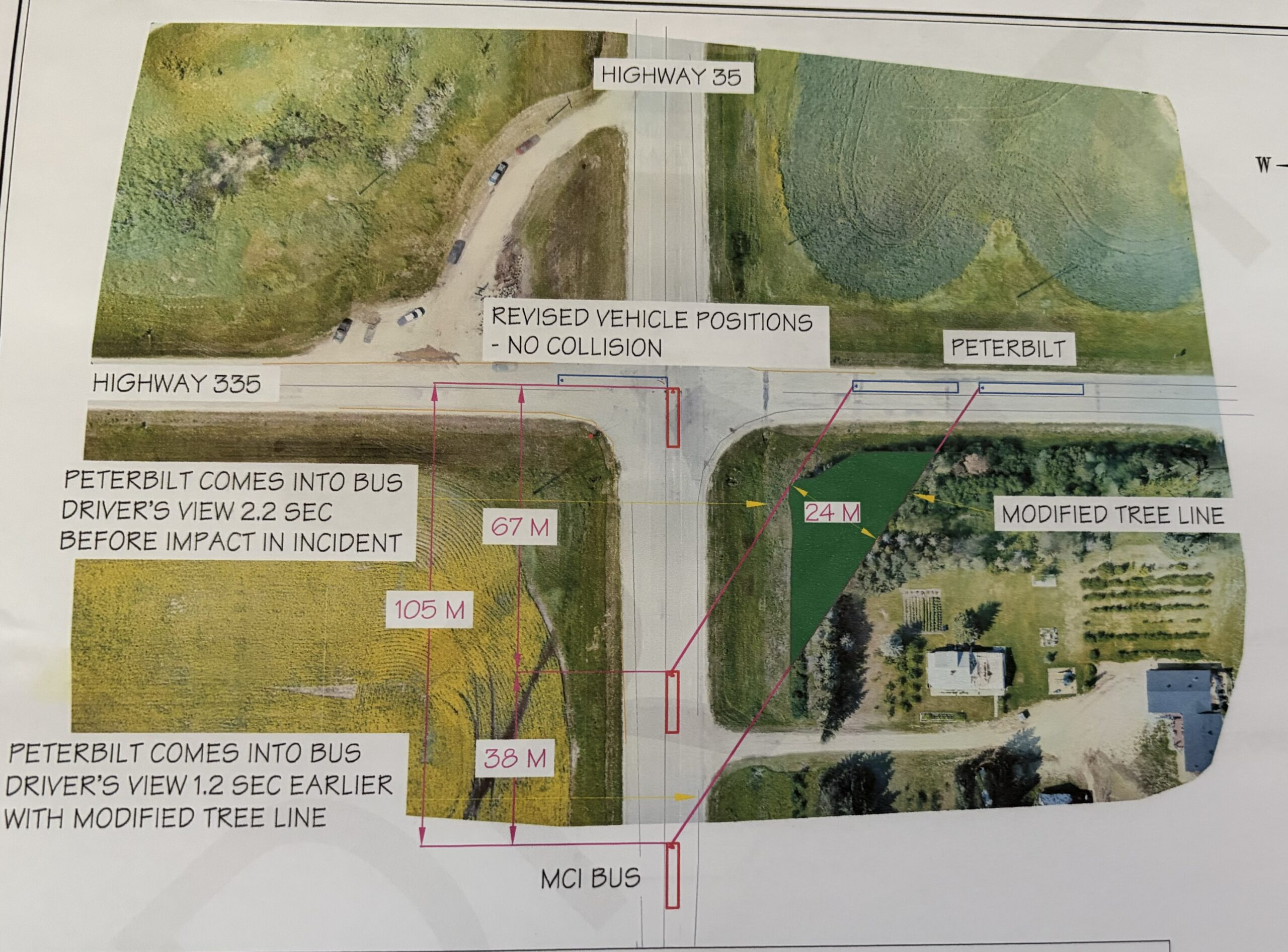
7.4 Collision avoidance with earlier detection: “Had the driver of the MCI Bus perceived the Peterbilt at least 1.2 seconds earlier than he did, the collision would have been avoided. The trees on the southeast corner of the intersection prevented the bus driver from viewing the Peterbilt until 2.2 seconds before the collision. After perceiving the truck as an imminent hazard and determining his response, the driver of the MCI Bus braked for about 0.8 seconds to deposit a 24.08 m skid mark.
“In order to delay the MCI bus arrival at the point of impact by 0.6 seconds and avoid colliding with the Peterbilt, the driver of the MCI Bus would have been required to perceive the Peterbilt 1.2 seconds earlier, thus applying the brakes earlier. This lengthened braking distance would have sufficiently delayed the bus’s arrival at the point of impact so that the Peterbilt would have passed by.”
“At a distance of 105 m from the point of impact, the trees on the southeast comer of the intersection interfered with the bus driver’s visibility of the approaching Peterbilt. The vegetation prevented the driver of the northbound MCI Bus from seeing the approaching westbound Peterbilt until it became visible beyond the edge of the trees. Had the vegetation been cut back 24 m further to the southeast, the Peterbilt would have come into the northbound bus driver’s field of view 1.2 seconds earlier.”
Moreover, Herold alleges that this deadly circumstance was foreshadowed in a design manual for intersections that was previously available from the provincial government archives.
“I did a bunch of research on my own and put in a lot of Freedom of Information requests. One of the interesting things that I found was a design manual called the DM505. That was the government’s own design manual that lays out how intersections are supposed to be designed. You can’t get it now. It was available until about August 2018, then it just seemed to disappear from the government’s archive. That design manual describes exactly what happened in the crash.”
Grasslands News was shown that copy of the DM505. In the section entitled “Accident Causes” it states: “An examination of accident statistics shows that in many of the accidents, drivers did not obey the regulatory signs before entering the highway…the driver on the through highway must be protected by having adequate sight distance to permit him to perceive movements on the minor road and to give him sufficient time to be prepared for all eventualities. In the case of rural highway intersections, adequate sight distance is very essential since, due to the high speeds involved, the consequences of this type of accident can be very severe.”
Mellor contends that by failing to ensure that the sightlines at Armley Corner met the standard set in the DM505, the government also failed Glen Doerksen and his passengers.
“What does it mean when we say that the government is responsible for engineering an intersection? I would argue that engineering an intersection also includes maintenance because who else is responsible for maintaining an intersection?”
“The whole purpose of the DM505 is to design an intersection of the highway that allows the dominant driver (in this case Glen Doerksen) to take corrective action and save his own life and the lives of his passengers if the subservient driver (in this case Sidhu) does not follow the law and stop.”
“So, the government failed to engineer that intersection properly, because they didn’t maintain the intersection and didn’t follow the standards set out in the DM505, their own design manual.”
“I would argue that’s where the government has let everyone down. Yes, they installed oversized stop signs on the #335, and there were four signs before that warning of the intersection ahead. But if the driver on the #335 highway chooses to disregard those signs, as Sidhu did, then Glen Doerksen should have been able to save himself and his passengers had the intersection been designed, engineered and maintained in accordance with the DM505.”
Herold maintains that following the completion of its own safety review of Armley Corner in November 2018, the provincial government put further safety measures in place at Armley Corner.
“The government went and trimmed back the trees on the portion of land there that they owned and cleaned up the ditch. Then they had discussions with the landowner who was there and ended up expropriating some of his land and cutting those trees out, too. They also put in rumble strips on the corner and a new turning lane in. You wouldn’t recognize the intersection now. It’s completely changed.”
Russell wonders why these actions were taken only after the crash that killed his son.
“Why? Why did they do this only after the kids were killed? Just so they could have the satisfaction of pointing and saying, ‘Look at all that we’re doing’? They were warned in 1997 that the trees were a problem. Why was nothing done before this crash happened?
On March 18, 2020, the provincial government was added as a defendant in the civil action that had been launched by the Herold family. Herold and his lawyers maintain that the overriding purpose in doing that was to hold the government accountable.
“My goal was to see accountability from the government,” says Herold. “I wanted to see change, so that this didn’t happen again. Even one person killed in something like this is too many. I don’t want to see anyone else go through this.”
“The issue is accountability,” Fox agrees. “How do these tragedies lead to safer roads? We say that’s through accountability. Without it there’s no incentive to change. There are lessons that must be learned from this, and these kinds of lessons can’t be learned without transparency, meaningful answers and accountability.”
“It’s the government’s mandate to protect the public,” Mellor insists. “When it fails to do that – people die. That’s exactly what happened here.”
Fighting to be heard
Justice delayed is justice denied.
This adage contains a hard truth.
When we are wronged, when we experience a hardship or loss due to someone else’s actions or inactions, we want justice immediately.
Yet justice can be maddeningly elusive.
The family of Adam Herold, the youngest person killed in the 2018 Humboldt Broncos Bus Crash, launched a civil action, naming both the driver and the trucking company he had worked for as defendants.
Then, on March 18, 2020, the families of four others who had been killed in the crash joined the civil action and the Saskatchewan government was added as a defendant. The families, along with the lawyers representing them, Kevin Mellor and Sharon Fox, allege that because it failed to properly design and maintain the intersection where the crash occurred, the government bears significant responsibility for it.
But by November of that year, the lawsuit was facing significant delays.
When Kevin Mellor voiced that adage, warning that “Justice delayed is justice denied” during an interview on the courthouse steps, it was not yet evident how prophetic his words would prove to be.
“We were supposed to argue an application to strike the government from the claim as a defendant in November 2020,” Mellor explains. “When we showed up to do that, we found out that the lawyer for a proposed class action suit had contacted the court and did not want us to move forward because he wanted to make representation on behalf of his clients. He said that his clients would be prejudiced if our action went ahead.
“That was the day I was interviewed on the courthouse steps.
“The judge accepted the argument from the class action lawyer and wanted us to work together for a solution. But this proposed class action involved suing not only the federal government but Glen Doerksen as well. We wanted nothing to do with that. Glen Doerksen lost his life trying to save his passengers; we wanted no part of a lawsuit that blamed him for what happened.”
“By January 2021, we indicated that we couldn’t come up with a solution,” Mellor continues. “The lawyer then brought an application to stop our action, and it was granted. So, we had to go to the Court of Appeal, and they ruled in our favour in 2022, saying that a Class Action couldn’t stop an independent action from proceeding. But by that time, we had been delayed for two years.”
Efforts were made to proceed.
But further delays found their way into the courtroom.
Finally, Judge Mitchell’s decision was handed down on December 16, 2025.
As of that date, the Government of Saskatchewan had not chosen to file a Statement of Defence in response to the allegations advanced.
In his decision, Judge Mitchell concluded that the arguments put forward by the plaintiffs “lacks merit” and that “Even accepting all allegations in the Proposed Pleading to be true, it is plain and obvious that it is doomed to fail.”
The civil lawsuit that the Herold family had initiated just months after their son was killed was dismissed.
Fox notes that after pressing on through the delays, the decision to dismiss the lawsuit was hard on the families.
“Seven years is an anomaly. Usually, three to four years for a King’s Bench action from start to finish is a long time,” she says. “Having this drag on means that these families have had to relive the worst day of their lives over and over for seven years – only to be told that their claim doesn’t even have enough merit to be heard in court. That is a pretty significant mental and emotional loss that these families have to cope with. It leaves them with no way to heal – this remains an open wound.”
One factor that Judge Mitchell stressed in his decision was the GoFundMe that was created soon after the crash. Russell Herold and his lawyers question why the GoFundMe was deemed relevant.
“Reading the decision felt like a slap in the face,” Herold says. “The emphasis on the GoFundMe was especially hard to take. I don’t know who started the GoFundMe. It began before our court action began – I think a day or two after the crash. It was a public fundraiser that wasn’t really intended to raise as much money as it did. But it grew and grew when people realized the devastation of what had happened. Someone started it to try to help. What part did that play in this?”
“I would argue that the GoFundMe has zero significance in this,” says Mellor. “If people want to help victims of a tragedy that is their business. This has no bearing on holding the government responsible for its grossly negligent conduct in the design and maintenance of the intersection. The improper design contributed significantly to the death of these kids.”
“What does the GoFundMe have to do with accountability from the government?” asks Fox. “How does the GoFundMe ensure there are safer highways? How does it provide any incentive for change? Those were the three purposes of the parents who brought this forward in the first place. It has never been about money.”
“And the most frustrating thing is that the majority of the families who received money from the GoFundMe used it to start a foundation or do something else to honour their children,” Fox continues. “They didn’t keep the money for themselves. They wanted to use that money to effect change, to honour their children’s memory and create a legacy in their names that would benefit the community.”
In his decision, Judge Mitchell ruled that the government could not be held liable due to No Fault Insurance.
“The effect of the judge’s decision is to provide the government with a shield that is its own legislation, allowing them to say that they aren’t responsible because a motor vehicle was involved,” says Fox. “Their argument is that this was caused by a motor vehicle accident, and therefore, the government cannot be held responsible under No-Fault Insurance. We don’t agree. We argue that this crash was caused by inadequate sightlines and government inaction. Our position is that this was caused by the government failing to properly design and maintain that intersection, which is something that they have the social, moral, and legal responsibility to do, in order to protect the people on our roadways.”
Fox goes on to say that all legislation must be Charter-compliant and insists that the legislation which created No-Fault Insurance fails to meet that standard.
“The Charter of Rights and Freedoms is the superseding law of Canada. The provincial government’s legislation has to be Charter-compliant. We argue that this legislation is not Charter-compliant because it has the effect of depriving our clients of the right to life, liberty and security of the person by not allowing them to hold the government accountable for its action and inaction. And Charter rights are meaningless if they disappear when the defendant is the government.”
Mellor contends that the government’s claim that it falls under No-Fault Insurance is not consistent with the original purpose of the legislation that created it.
“The Automobile Accident Insurance Act was designed in the 1990’s because when a person was in a car accident and sustained an injury, they would have to sue to get the benefits they would need to navigate through their life,” he explains. “The government at that time said – hold it – there are people who can’t afford to go through with a lawsuit. Therefore, they won’t receive any compensation, and they will become a burden on the system. So, the government decided to pass legislation that gave victims compensation so they could live, regardless of who was at fault. That was the purpose of that legislation.”
“What we’re arguing is that it was never the purpose of that legislation to allow the Government of Saskatchewan, which we contend was negligent in their responsibility to design and maintain a safe highway, to get out from underneath that responsibility by putting themselves under No-Fault Insurance. That wasn’t the purpose of the statute.”
“The government is saying that if Mr. Sidhu had stopped at the stop sign, there would have been no crash and no deaths. That is true. But we argue that even though Mr. Sidhu did not stop at the stop sign, if the government had done its job and designed and maintained the intersection properly, Glen Doerksen would have seen the truck coming and had enough time to stop the Humboldt Broncos bus. That would have prevented the crash, and there would have been no deaths.”
Mellor goes on to argue that the government had ample warning that a deadly situation existed at the intersection.
“The accident that happened at that intersection in 1997 gave the government a warning that there is a serious design problem here,”Mellor maintains. “The Stevenson Report pointed out the trees that were blocking sightlines for northbound and westbound traffic. And the Ministry of Highways received a large number of letters from MLAs, civil engineers, RCMP officers, the coroner and others who were asking for changes to that intersection to make it safer. These were high-level warnings. These letters weren’t coming from people who had just seen a few rolling stops. These were red flags, warnings that the government should have paid attention to.”
“It’s the government’s mandate to protect the public by engineering and maintaining highways and intersections properly, and in accordance with their own standards, so that they are safe,” Mellor contends. “And the design and maintenance of an intersection has nothing to do with a motor vehicle. The government is saying that because a motor vehicle was involved in this crash, they fall under No-Fault Insurance under which nobody can be sued, much less the government.”
“But it is an absurdity to say that the government falls under No-Fault Insurance when their conduct, which caused the crash, has nothing to do with a motor vehicle and nothing to do with No-Fault Insurance. What we are arguing is that you have to satisfy the purpose of the No-Fault Insurance legislation in order to fall under it. We contend that the Government of Saskatchewan is not subject to No-Fault Insurance, but rather to the Highways & Transportation Act 1997.”
“The Government of Saskatchewan has never argued that they were not negligent,” Mellor maintains. “But they argued that we are statutorily barred from suing them for their negligence because a motor vehicle was involved.”
Russell Herold maintains that this decision leaves his family and the other families included in this civil action feeling as though that prophetic adage has come true.
“I feel that we’ve been denied justice and the ability to show negligence on the part of the government. Basically, the government is hiding behind No-Fault Insurance. I don’t think that’s right. Our kids died because that intersection wasn’t designed or maintained properly. If it was so safe, why did they finally do all of the things that people had been asking them to do after the bus crash?”
The families have decided to appeal this decision, and Fox says that their hope is that a successful appeal might give them back some hope for justice.
“Our clients hope that the decision will be overturned and there will be an order that they can proceed with their action, so that the government can be held accountable. Because that’s all they have wanted from day one – accountability.”
Hearing the truth
In a world where we are bombarded with data, theories, and an endlessly shifting array of dogmas that are marketed as fact, truth can be hard to hear. And while we look to screens for information, insight, and connection – we forget that screens were originally created to conceal, and that often the truth we most need to hear can be easily silenced under the weight of popular opinion.
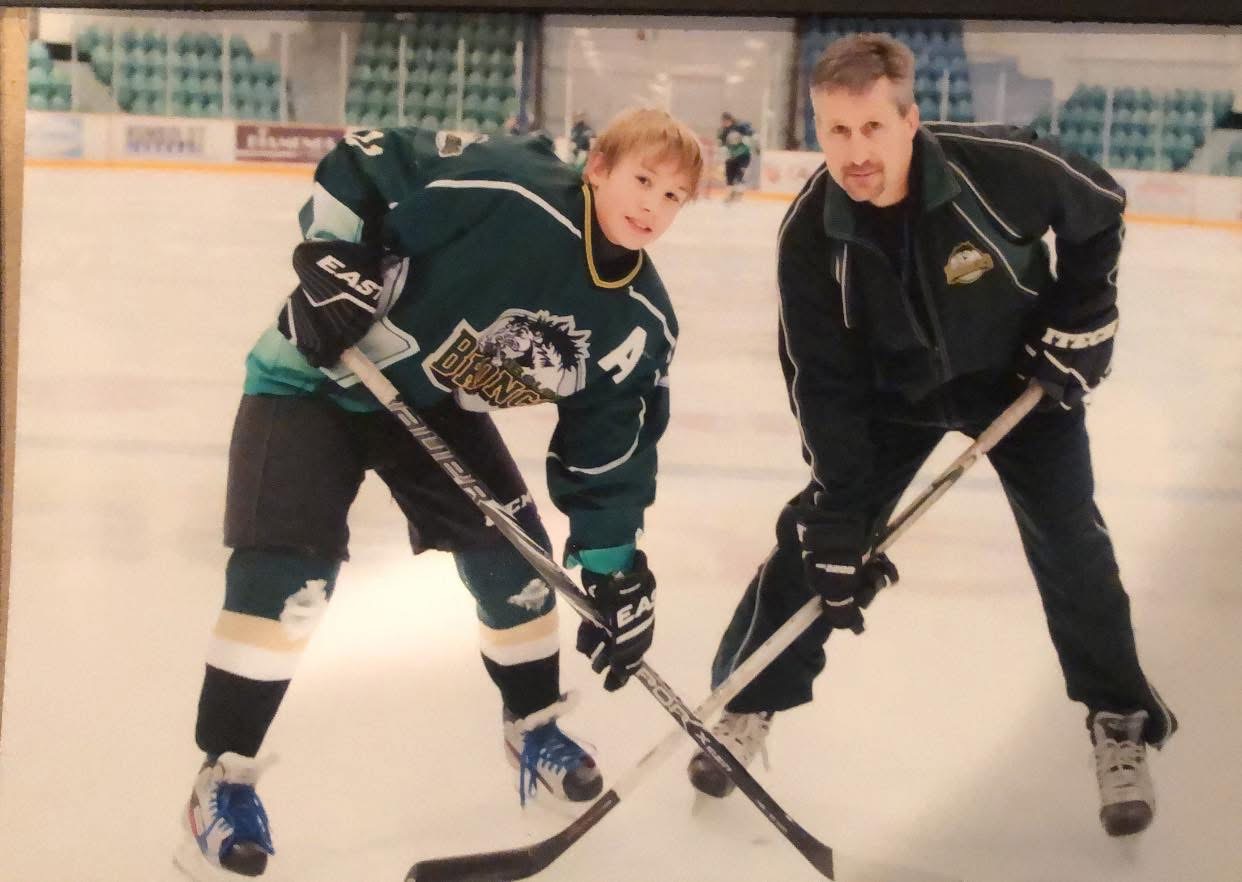
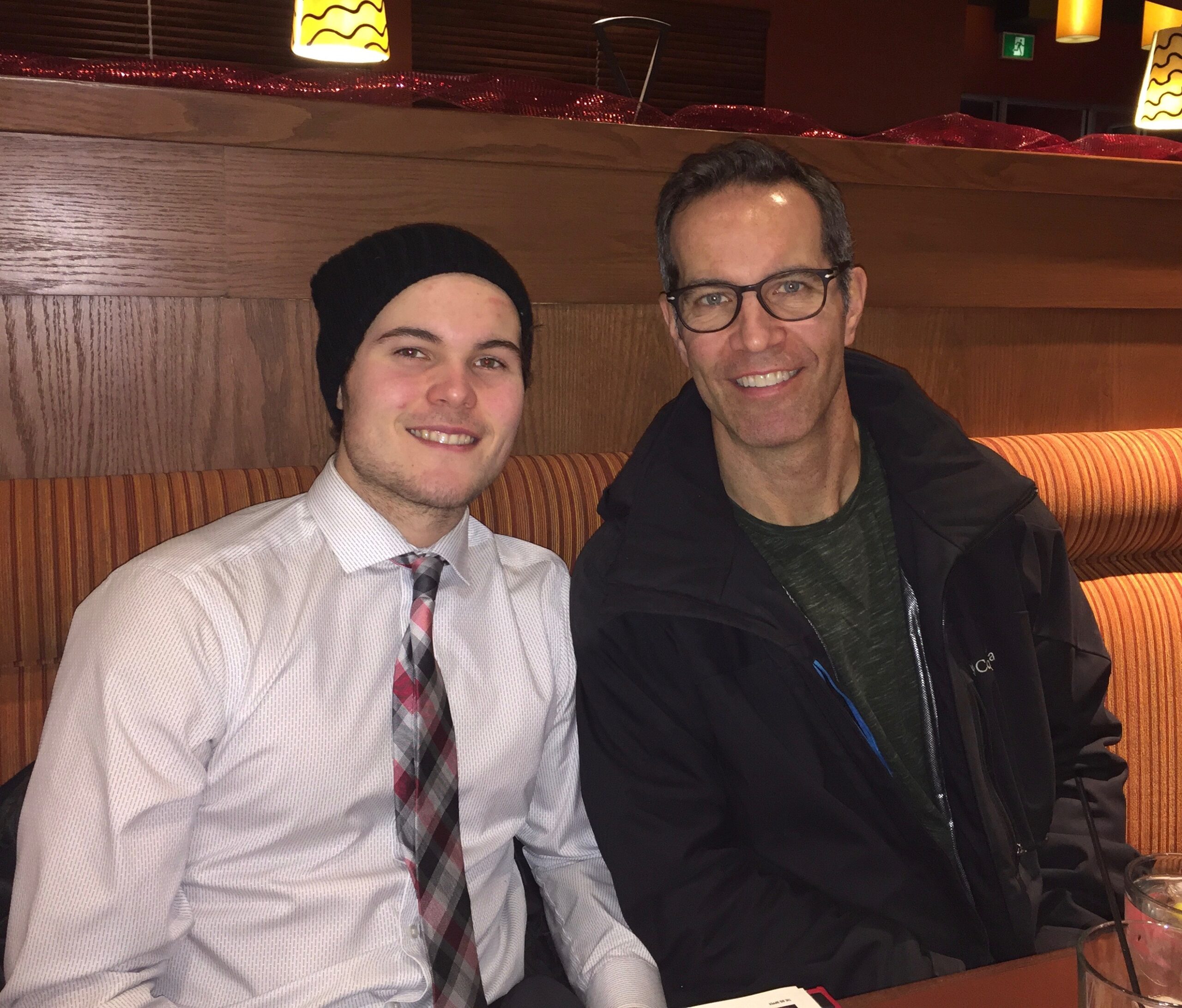
Chris Joseph and Kurt Leicht, whose sons Jaxon Joseph and Jacob Leicht were killed in the Humboldt Broncos bus crash, say that much of the truth about what happened that day has been stifled under assumption and the popular opinion often constructed through media reports. Moreover, both maintain that this has obscured how those systems we depend on for justice failed the victims of the crash and all who love them.
Certain facts about the crash are known.
On April 6, 2018, Jaskirat Singh Sidhu was driving a Peterbilt pulling two ‘Super B’ trailers loaded with bales of peat moss west on Highway 335. Sidhu passed four signs warning of the major intersection with Highway 35 that he was approaching, before reaching the oversized stop sign (that was four feet in diameter with a flashing red warning light above it) located at that intersection. Sidhu did not attempt to stop. Instead, he drove into the intersection at highway speed, directly in front of the bus carrying the Humboldt Broncos hockey team. Although the bus driver, Glen Doerksen, attempted to stop as soon as he saw the semi, he was unable to avoid the crash that left 16 people dead and 13 severely injured.
These facts were contained in a court document called the Agreed Statement of Facts. While they outline what happened and verify that Sidhu’s actions caused the crash, these accepted facts offer no insight into why he failed to stop at the stop sign.
Yet media reports frequently provide a “why”, stating that Sidhu was distracted by improperly secured tarps covering the peat moss that had begun to flap and balloon. Often, these reports claim that Sidhu stopped the semi and unsuccessfully tried to secure the tarps. But because the problem persisted, Sidhu was focused on watching the tarps in his side and rear-view mirror and therefore failed to see and heed the warnings about the approaching intersection or the stop sign.
There is no mention of tarps in the Agreed Statement of Facts.
But the document does note that, “The sun did not interfere with Mr. Sidhu’s ability to operate the semi-tractor unit or view the intersection.”
Why is this?
Chris points to what he contends is an inconsistency in Sidhu’s story.
“The first story we heard a day or two after the crash, was that the sun had been in Sidhu’s eyes,” he said. “But at that time of year and that time of day, the sun was still pretty high in the sky. So, it was easy to prove that the sun wasn’t an issue. Then about two or three weeks later we heard about the flapping tarps. That is completely unprovable. But there are statements from the people at the place where he picked up the peat moss that said his load was tarped as good as usual. And the people who had sent him on his way didn’t notice anything wrong.”
Chris adds that there were also serious questions about how Sidhu had been allowed to get behind the wheel of that Peterbilt.
“Who trained Sidhu? Who signed off on him?” he asked. “We really don’t know anything about the trucking school he is supposed to have attended. All that happened to the trucking company was that they had to pay a $5,000 fine, and the owner was trying to get trucks back on the road three days after the crash. Luckily the Alberta government caught him and shut him down. But there was never any accountability.”
Had a trial taken place, these questions would have been asked in court.
However, at the beginning of what should have been Sidhu’s trial, he pled guilty to 16 counts dangerous driving causing death and 13 counts of dangerous driving causing bodily harm.
So, a trial did not take place.
Often, media reports claim that Sidhu’s decision to plead guilty was prompted by a desire to spare the families the pain of a trial. But both Chris and Kurt say that the trauma brought about by four days of Victim Impact Statements at Sidhu’s sentencing hearing was made worse by lack of answers a trial might have brought.
“I laughed when I heard that he was trying to ‘spare us a trial’” says Kurt. “As if he could ‘save’ us from anything we were going through! And going through the victim impact statement and sentencing didn’t bring any closure.”
“The worst week of my life was the week of the crash, and the second worst week was the sentencing hearing,” Chris remembers. “We sat from nine to five through four days of Victim Impact Statements. From our family alone, there were statements from Jaxon’s mom, dad, sister, brother, grandma, grandpa, billet parent, and girlfriend. That was only our family. We cried our eyes out giving those statements. Then, we sat and listened to the statements from all the other families, and there were multiple people speaking from each of those families.”
“Was it traumatic? Yes. Would a big ugly trial have been traumatic? Yes” he continues. “I will say that at the time I was grateful that we wouldn’t have to go through a trial. But I was grieving so hard that I didn’t realize a trial would have brought up a lot of questions and exposed a lot of the things that didn’t add up. We had the ugliness anyway. But we weren’t allowed to ask any questions at all during the sentencing hearing. So, we had no answers.”
Sidhu was given the longest sentence for dangerous driving causing death and dangerous driving causing bodily harm ever handed down in Canada. However, both Chris and Kurt say that it was not the sentence many families had hoped for.
“When they told us that they were going to ask for a 10-year sentence, every family was in the room,” Chris says. “Many of us asked why they weren’t going for the maximum 14-year sentence. The Crown Prosecutor Thomas Healey said that he didn’t think that was realistic – he didn’t think we could get that. It didn’t make sense to me.”
“When Healey said he was going for 10 years, my reaction was that he should ask for 14 – the maximum,” Kurt recalls. “Sidhu deserved every day that he spent in jail.”
While Chris acknowledges that Judge Inez Cardinal sought to impose a fair and just sentence, he argues that those efforts were negated by a statutory release policy that prevented Sidhu from serving his full sentence.
“Since the Humboldt Broncos’ crash, the maximum sentence for dangerous driving causing death has been increased to 25 years,” he notes. “It set a new precedent. But Sidhu served a total of three years and 10 months – which is about three months per each person that he killed. Judge Inez Cardinal tried to hand down a fair sentence, but it was irrelevant because Sidhu was never going to serve that full sentence. After Sidhu was granted parole in 2023, we were told about ‘statutory release,’ and it was explained to us that they couldn’t hold Sidhu for longer than two-thirds of his sentence. I heard that and thought, then what good is a sentence?”
In deciding to impose an eight-year sentence rather than the 10 years the Crown had sought, Judge Cardinal had also considered various mitigating factors. One of these was the fact that because Sidhu was a Permanent Resident of Canada rather than a Canadian Citizen, he would be deported back to India because of the conviction. However, since being released, Sidhu has made repeated attempts to avoid deportation and remain in Canada.
In December 2023, a federal judge dismissed an application from Sidhu’s lawyer, who had argued that a Canadian Border Services Agency recommendation that Sidhu be deported back to India was unfair and unreasonable. Sidhu subsequently lost his Permanent Resident status, and in July of 2024, Sidhu’s lawyers filed an application to restore his Permanent Resident status on humanitarian and compassionate grounds. That application was transferred to the Immigration, Refugees and Citizenship Canada Headquarters in Ottawa for determination by an Immigration Officer and has not yet been heard. But the order to deport Sidhu remained.
Last month, CBSA indicated that Sidhu would be deported on April 27. However, on April 22 his lawyers filed a motion for a stay of his removal. A decision on this motion was handed down by Judge Jocelyne Gagné on April 24.
In reaching her decision, Gagné wrote that she had considered arguments made by Sidhu’s lawyers that he “demonstrated a high level of remorse and developed severe Post-Traumatic Stress Disorder and major depressive disorder” as a result of the crash. She also considered the argument Sidhu’s lawyer presented that neither the “overwhelming medical evidence” indicating Sidhu would “present a high risk for suicide” if deported to India without his family support nor the best interests of his two Canadian-born children, “especially the interests of the three-year-old son who has severe health issues,” had been “properly considered” or “properly assessed” by the CBSA.
Consequently, Gagné granted a stay of Sidhu’s removal from Canada to India pending final determination on a first-stage decision on his application for permanent residence on humanitarian and compassionate grounds. It may be close to two years before a decision on that application is rendered.
Both Chris and Kurt maintain that the mental anguish suffered by the families and others who were forced to bear the burden of what happened is not being considered.
“I can understand why Judge Gagne wouldn’t want Sidhu’s suicide on her conscience,” says Chris. “But my biggest issue with her judgement is that she didn’t take the families into account. CBSA did. The Immigration and Refugee Board did. The Federal Judge that heard his appeal did. They ordered him deported. But Judge Gagne believed his story without taking our feeling into account. There are 29 families who are traumatized. My son had a girlfriend. She was traumatized and so were her parents. And the number of people these boys touched during their lives is astounding. So, you can’t even say it was only the families that were impacted. Yet it’s all about how one guy is affected by this? People are missing the point.”
“And what about the first responders, and every doctor and nurse that was involved?” asks Kurt. “Three people who were directly involved in dealing with the crash have never returned to their work since that night. His mental health is more important than theirs? The federal government is willing to offer MAID to veterans and others who have PTSD or have a mental illness. But it’s okay to bend the immigration rules to prevent Mr. Sidhu from committing suicide?”
Lost amid noise of media reports and conflicting public opinion is the impact on families who have now served the full eight years in what is for them a life sentence. Chris talks about how the moments they live now and the future they hoped for have been impacted by the crash.
“It’s with us forever,” Chris observes. “One of Jaxon’s buddies on the team is now married with a baby. That’s something that Jaxon never got to experience. My wife and I want grandchildren. We would have loved Jaxon’s children and his wife dearly. And we’re missing all of that.”
“There are also those special moments that families should share,” he goes on to say. “My daughter got married a couple of years ago. We were determined to celebrate – this was a joyous occasion. But Jaxon should have been there. I know that in every moment like that, there’s always somebody missing that should have been there. But when the chance to be there is taken from someone the way it was taken from Jaxon – when it is so avoidable – that hits hard. So, every celebration we have – and we have many – has that tinge of bitterness to it because Jaxon should be there.”
Kurt talks about the way that Jacob’s siblings have been affected by his death.
“My family grew up here in Humboldt. I lived every day in that rink,” he recalls. “All my kids took skating lessons and two played hockey. It was so hard and it was very hard on our kids. My second son really struggled because he and his brother were just starting to hang out – he was 16 at the time. Our oldest daughter was a hockey player, and her big brother was her idol. They had so much in common. She lost him and she lost all of that. And his little sister – she lost the person who always took care of her. Everyone’s journey is different. The waves that come and go – that sadness – nobody can tell you how to get through that. That’s the bottom line. But some days I don’t know how we made it through.”
Kurt goes on to say that he will continue fighting for the justice that he feels was denied to all the victims of the Humboldt Broncos’ bus crash
“It brings a lot of anger for me about how things were done,” he explains. “We could never get to the truth. We were never able to express ourselves about what we thought should happen. And that was our fault because we thought – like good Canadians – that somebody would be taking care of that. We thought the system would work. So, it’s been pathetic to watch the system fail. I can’t believe that it’s been eight years and we’re no closer to the truth and to justice than when we started. None of the truth was allowed to come out about how the trucking company was at fault. The owner of the trucking company should have been in jail – but nothing happened. And eight years later we still don’t know why Sidhu drove past that stop sign.”
“But Celeste and I are both fighters, and I’m not scared to be vocal,” he adds. “People might not like hearing what I have to say. But I will keep standing up. Something has got to change. People have to hear the truth.”
There are plans to have a permanent memorial to those killed in the Humboldt Broncos bus crash erected at Armley Corner.
This is a good thing.
Memorials serve an important purpose.
But memorials are silent.
Perhaps to truly honour those killed and injured in that crash, something more than silence is required.
Perhaps questions must be asked and those responsible for what happened that day must be required to answer and account for what was done and not done.
Perhaps it is time for silence to be broken.