

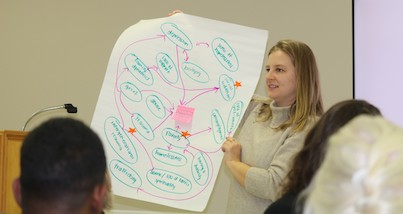
Exploring Yorkton’s Future, an interactive workshop aimed at developing a more collaborative, sustainable, and prosperous future for the city was held in Yorkton recently.
The workshop last week was organized by Local Futures in partnership with the University of Saskatchewan. This initiative is part of a national project designed to bring together community organizations, municipalities, and academic partners to address local challenges.
The process put forward 17 broad goals – things such as no poverty, zero hunger, affordable and clean energy, quality education – and then challenged those in attendance to focus on how to collaborative work toward them.
It was a first step in the Local Futures project which aims to drive a new wave of Sustainable Development Goals (SDGs) localization throughout Canada, aligning the international focus of the SDGs with local priorities in Canadian communities.
This work will:
• Focus on the creation of municipal reporting on the SDGs
• Facilitate a collective impact model for community stakeholders to advance the SDGs collaboratively with their local government
• Develop new sets of localized SDG indicators and data points for municipalities to track their progress
• Inspire a deeper integration of the SDGs across the country through the development of learning resources, annual gatherings, and resource sharing.
“It all starts with what’s your vision for a better world,” said facilitator Jon Beale.
The core idea of the project is “to move past business as usual . . . and get us on a better path,” he said.
The changes though need not be dramatic to be impactful.
“We can make small shifts today . . . that really lead to big impact into the future,” said Beale.
The changes can be impacted by anyone, and what one group or business does can have a ripple effect on the efforts of others.
“It’s not looking at things in isolation,” said facilitator Laura Carr-Pries, adding a problem that needs addressing does not exist in a vacuum.
Yorkton Mayor Aaron Kienle said he sees the process as a good one.
“I’m really excited about this work,” he said, adding he went through a similar process and “the work was good. I was challenged …
“I think it’s a great opportunity. We are one of five communities in Canada doing it.”
The other communities undertaking the process are Kitchener, Kingston, Halifax and the Mount Arrowsmith Biosphere Region, British Columbia.
It’s a case where the objective of looking ahead makes so much sense, said Kienle.
Kienle said the goals outlined make sense.
“They all are so good,” he said, adding when you look at them they are ones “we’re all kind of doing.”
That is important. They are goals the community can share.
“The Sustainable Development Goals are a collective impact framework,” notes uwaterloo.ca. “They embody a “whole of society approach” and explore how each of the issues represented by the 17 SDGs are closely interconnected with each other. Anywhere the SDGs are mentioned the message is always very clear – it is only by working together, across sectors and issue areas, that the ambitious agenda of the SDGs can be achieved.”
The University of Waterloo is a partner with Dr. Robert Patrick (Professor of Regional and Urban Planning in the Department of Geography and Planning), Janelle Hutchinson (Chief Sustainability Officer), Stephanie Ortynsky (Research Associate, Saskatchewan Urban Municipalities Association), and Matt Wolsfeld (Reporting and Engagement Specialist) from the University of Saskatchewan to bring the Local Futures project to life in the City of Yorkton, Saskatchewan.
Ortynsky is also a Yorkton councillor who was instrumental in Yorkton being one of the five communities chosen, adding she saw it as an opportunity to gather community knowledge to support a collective move into the future.
Key aspects of Yorkton’s future planning include:
• Workshop Focus: Collaborative, sustainable development, with lunch provided for participants.
• Infrastructure Investment: Upgrading key transport routes like Grain Millers Drive to enhance agricultural logistics.
• Regional Growth Strategy: Collaborative efforts between local, provincial, and federal partners to foster responsible growth.
• Economic Advantages: Positioning as an affordable city with lower taxes and development charges than major Saskatchewan cities.
• Economic Base: Strengthening sectors like manufacturing, agriculture, and food processing.
The process of community input will continue with a final report expected late this year or into 2027.