
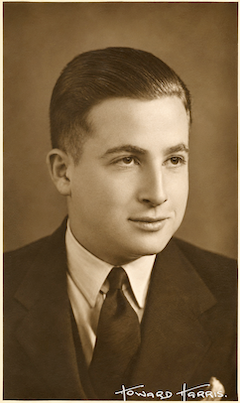
While all the individuals honoured with banners through the Royal Canadian Legion General Alexander Ross Branch No. 77 – Yorkton have stories none are any more unique nor tragic than that of Wilfred John Peter Tibbits.
Born in 1919 in Goulburn Mulwaree Council, New South Wales, Australia Leading Aircraftman Tibbits was with the Royal Australian Air Force in WWII.
But, yes, there is a connection locally – he died flying here and is buried in the local cemetery.
After flying training in Narrandera NSW from 6 February 1941, he embarked for Canada on 22 April 1941 and arrived in Vancouver on 14 May 1941. He’s recorded as being attached to the RCAF from 22 April 1941. During the Second World War, John (as he went by) was a part of the Royal Australian Air Force and trained in Yorkton, SK as part of the British Commonwealth Air Training Plan, detailed information via the Yorkton branch of the Legion.
The British Commonwealth Air Training Plan was a massive World War II program established to train pilots and aircrew from the British Empire and Allied nations in Canada, details thecanadianencyclopedia.ca. Between 1940 and 1945, air schools were set up in hundreds of communities — including Yorkton with one hangar from that time still in use at the local airport — across the country, in every province except Newfoundland (which was not yet part of Canada).
“The plan’s mandate was to train Allied aircrews for the Second World War, including pilots, navigators, bomb aimers, wireless operators, air gunners, and flight engineers. More than 130,000 crewmen and women were trained between 1939 and 1945,” stated the site.
Tibbits was one of the casualties of training (there were 17 plus one civilian) at the Yorkton BCATP location.
He “died during a training incident near Dafoe while stationed in Yorkton on June 13, 1941,” stated material from the Legion.
“Family recollect that John misjudged his altitude while performing a low loop and crashed. John was interred at the Yorkton City Cemetery with a Commonwealth War Graves Commission headstone.”
But as there often is there is more to the story.
It started with the Legion banner program deciding to honour Tibbits with a banner this year.
And it continued with an effort to find family in Australia.
Once found the connection grew, offered Legion president Brittany Johnson, including having a duplicate banner created to send ‘Down Under’.
“I sent a letter and I will be emailing the video of the commemoration service to them. I sent pictures previously of the airport and the headstone and the memorial at the airport,” she said.
The letter with the banner noted, “the banner enclosed with this letter is the same banner that hangs along Broadway in Yorkton in John’s honour. The Yorkton Legion Branch 77 wanted you and your family to have one of your own—not simply as a piece of Yorkton history, but as something that connects your family in Australia with the place where John spent his final days and where he now rests.
“I hope you will see it as more than a commemorative banner. I hope you see it as a piece of the place that now holds a part of your family’s history. It is our way of reaching across those thousands of miles and saying to you and your family: we remember him here, too.
“So, Patrick, when you look at this banner, I hope you can picture the street in Yorkton where it is hung. I hope you can picture the cemetery where he rests, the Commonwealth War Graves marker that bears his name, and the Australian flag beside it each spring.”
The connection came out of the blue for the family in Australia.
“Legion volunteer, Brittany Johnson, found me last June and told me of the Legion’s plans to commemorate my late uncle, John Tibbits,” said Patrick Lindsay, who was good enough to reply to a few Grasslands News questions via email.
“She asked for some details about John so they could add a small biography to the banner.”
Lindsay added Wilfred John Peter Tibbits, known to his family as John, was his uncle, his mother’s only brother.
“They grew up in a tiny town in western NSW called Gilgandra, where their father was a stock and station agent; rural property realtor,” said Lindsay.
So, what was the family’s reaction to being contacted all these years after Tibbits’ time here?
“It came completely out of the blue, but I was delighted that John had not been forgotten so many years after his death in 1941,” said Lindsay.
“I’m an author and filmmaker and I’ve written many books on Australia’s wars and our veterans, so commemoration is very dear to my heart.”
Lindsay did know of his uncle in spite of the time and distance of his death.
“My Mum died many years ago, but she always talked about John during my childhood,” he said. “I don’t think she ever really got over his death.
“I always knew a basic story of his service: that he enlisted in the RAAF (Royal Australian Air Force) when war broke out in 1939 and that he was sent to Canada to train as a pilot.”
But he was more than military too to his family.
“He was a good sportsman and student, and he worked in a bank before he joined up,” said Lindsay.
“Mum told us he died, aged 21, on his final test flight before he would have been awarded his wings on 13 June 1941.”
The tragic death created something of a connection of place for the family.
“Mum told me that a number of Yorkton locals who met John during his training wrote to her after he died,” said Lindsay.
“They said he made many friends in the short time he was there and that his death was a great shock to the community.
The impact of finding out a son died thousands of miles from home was not lost on Johnson in the letter to Lindsay.
“The more you have shared with me, the more John has come to feel like a real person rather than simply a name recorded in history,” she wrote.
“He was someone’s son, someone’s brother, someone’s family. He had a home in Australia, people who loved him, and a life that should have continued for many years. Instead, his journey brought him halfway around the world to Yorkton, Saskatchewan, as part of the British Commonwealth Air Training Plan. Tragically, it was here, while training, that his life came to an end.
“I often think about the distance between Australia and Yorkton. It is an enormous distance—not only measured in kilometres, but in everything that separates one home from another. John left Australia and travelled so far from the people and places he knew, never knowing that Yorkton would ultimately become his final resting place. It is difficult to imagine what it must have been like for your family when John left Australia, knowing only that he was going away to serve and train, and then to learn that he would never return home.”
Interestingly Johnson was not the first letter from Canada to make its way to Australia.
“Mum corresponded with two local women for many years until her death in 1972. . . The ladies who corresponded with Mum after John’s death were Eva Davidson, an Englishwoman who was a refugee in British Columbia, and Millicent K McGuire, of Fox Warren, Manitoba,” said Lindsay.
Lindsay also provided a clipping from the Sydney Sun newspaper, which operated from 1910 through to 1988.
“Mum didn’t clip out the date, but it must have been around June-July 1941,” he said.
The small article was under the headline: Girl Thanks “The Sun’ For Memories.
In the newspaper article, it was noted: “Bittersweet memories were revived today for a Sydney girl who received two unexpected letters from Canada, sympathizing with her for the death of her air-man brother.
“We were much more than mere brother and sister,” she said. “We were the best friends in the world.”
“The two letters addressed, ‘Miss Nancy Tibbits, Sydney, Australia,’ came to The Sun, and within 48 hours The Sun had located her. This morning the letters were handed to her in an office in the City.
“Her brother, Leading-Aircraftman, Wilfred John Peter Tibbits, was killed on Friday, June 13, in Canada, when the trainer he was flying solo crashed.
“’I shall never be able to thank The Sun enough,’ exclaimed Miss Tibbits as she eagerly opened the envelopes.
“Each was written by a woman in Canada and expressed sympathy at Leading-Aircraftman Tibbits death.
“’I was in London during the last war helping with the entertainment of the Australian and New Zealand troops, and always thought what fine fellows they were. They are the same in this war,’ wrote the Englishwoman, Eva Davidson, now a refugee in British Columbia, who read of the accident in a Canadian newspaper.
Lost Brother, Too
“The second letter was written by Millicent K. McGuire, of Fox Warren, (sic) Manitoba. She told Miss Tibbits she had decided to write because her own brother had been killed in the last war, and she realized what a terrible loss it was.”
Now some 85 years later there is a banner in Tibbits honour hanging in Yorkton.
“It means a great deal to us,” said Lindsay. “Of course, I never met John, but he has been a distant presence in my life ever since I first heard his story from Mum.
“I think it’s a very generous tribute for the Legion and the community to commemorate his sacrifice.”
Flying ran in the family somewhat.
“Another of my Mum’s school friends also joined up and became a pilot and fought in Britain,” said Lindsay. “His name was Rawdon Middleton and he was awarded a posthumous Victoria Cross for his action in delivering his crew safely back to Britain after a raid in Italy even though he was mortally wounded.
“So I always thought that even had John Tibbits survived his training, he would have been long odds to ever safely return home.
“They were brave men and they were prepared to sacrifice their lives for our liberty.
“They all deserve to be remembered in spirit.”
In her letter Johnson assured he would be remembered.
“Each spring, an Australian flag will be placed beside his Commonwealth War Graves marker,” she wrote. “Seeing that flag beside his grave will be very meaningful. It is a little piece of Australia that will rest there with him—a reminder of where he came from and of the family and country that have never forgotten him.
“In some small way, I think John has found a second home in Yorkton.
“When I first began corresponding with you, I don’t think I fully appreciated where our conversations would lead. Learning about John through you, hearing about his family in Australia, reviewing his service file and the newspaper articles that you sent me and understanding more about the young man who came to Yorkton so many years ago has made his story feel much more personal.
“Every story and detail you have told me about John and your family has helped bring him a little closer to us. It has been a privilege to learn about the man whose name we see here in Yorkton, and to have the opportunity to connect with the family he left behind so long ago.
“We are grateful that you have shared his story with us and given us the opportunity to know a little about the man behind the name. He may have been born and raised thousands of miles away, but his name has become part of our community’s story. People here know that he lies in our cemetery and know his story. His grave is tended. His story is remembered. And when that Australian flag is placed beside his marker each spring, the distance between Australia and Yorkton will somehow feel a little smaller.”