
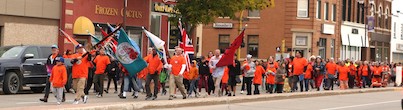
Truth and Reconciliation Day saw hundreds of people take part in a walk that extended three blocks down Broadway Street in Yorkton.
The large gathering, bolstered by students from several city schools, then gathered at City Centre Park to listen to speakers and have lunch.
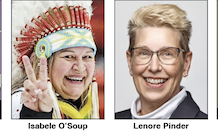
Yorkton Tribal Chief Isabel O’Soup thanked the large gathering she estimated to be about 1,000 — especially the youth — for being there “to help remember the little kids that didn’t make it home. We love it when kids can come. . . Honestly it means the world to us.”
O’Soup said attending an event such as the one in Yorkton Sept. 30, was important in terms of education as a way “to make kids aware in school.”
O’Soup said the stories are “not easy to listen to. They’re hard to listen to,” but it is important we do listen.
From the root of education can grow action, she suggested.
“We need to encourage our younger people to get involved,” said O’Soup.
The sharing of stories is also important to the storyteller, reminded O’Soup.
“It’s their way of healing when they continue to share their stories,” she said. A way of healing from “the atrocities they suffered when they went to the schools.”
Yorkton Mayor Aaron Kienle picked up on the message that the stories were not easy to listen to at times.
“It is a heavy day,” he said as he took to the microphone.
But, because it was ‘a heavy day’, he added “I’m so proud of you – so proud of the community coming together. . . This is building a better culture in our city.”
Yorkton MLA David Chan related that the day for him too was one difficult to find the right words for.
“I really struggled with what I wanted to say,” he told those gathered. “Today is such an important day.”
Chan also said that it was not his day, and that he was there to listen.
“I want to hear the survivors,” he said, adding a personal experience left its mark.
Chan spoke of a First Nations woman who told him how she would scrub herself in the shower until it nearly bled “to get the brown out of her skin.”
“That just undid my world,” said Chan.
Kienle said when people gather it is an important effort toward change. He said “solidarity . . . has always been powerful in the civil rights movement.”
Kienle did acknowledge “there are still people who don’t understand” the significance of the day and the need to reconcile, adding it is “so important.” That is why “showing up for each other” is important too.
“Be there for one another,” encouraged Kienle. “We believe there are better days ahead.”
To get there Chan suggested focusing not only on justice, but instead on love.
“Only you have the power of your own heart,” he said.
FSIN Vice-Chief Dutch Lerat spoke from his own experience.
“I am honoured to stand before you today . . . as a residential school survivor,” he said, reminding that through the years there were 21 such schools in the province.
Lerat said the stories are of “children that were taken from their homes . . . their culture” to a place they were told “their identity was something to be ashamed of. They had to leave an important part of themselves behind.”
But, First Nations persevered, said Lerat.
“We are here because our communities endured. . . Our families endured,” he said.
While there are survivors, not all did, and Lerat said the day is ultimately about those children.
“Today is about remembering the children who never came home,” he reminded, and then acknowledged the families and communities which “continue to live with the impact of residential schools.”
Fabian Head, Third Vice-Chief also reminded of why the day exists.
“Today is a time to reflect. . . to honour our residential school survivors,” he said, adding that there are survivors; it’s important to consider as it shows “. . . we continue to be resilient.”
“It is through days like the one in Yorkton, bringing people together with “First Nations and non-First Nations, learning to be proud of who they are,” said Lerat. “… You have a right to be proud of who you are and where you’ve come from.”
Truth and Reconciliation Day is for all, reminded Head.
“Today is a very important day for our people . . . All people in Canada,” he said.
The Government of Saskatchewan also recognized the day.
“Understanding the history and lasting impacts of residential schools is a responsibility we all share,” Minister Responsible for First Nations, Métis and Northern Affairs Eric Schmalz said in a release. “By listening to survivors and learning from their experiences, we can strengthen relationships with First Nation and Métis people and support continued reconciliation efforts across Saskatchewan.”
“You cannot have reconciliation before truth and the TRC was clear that Treaties are the truth of our shared history and must be the foundation of our governance on our Treaty territories,” Treaty Commissioner of Saskatchewan Dr. Kathy Walker said in the same release. “Honouring the Treaties are key to building relationships based on respect, peace and mutual prosperity.”
Provincial NDP leader Carla Beck also issued a statement.
“Each of us carries a responsibility to advance reconciliation and that requires more than words — it requires meaningful action. We must respect the Duty to Consult, protect Indigenous lands, cultures, languages and traditions, and continuing the work of implementing the Calls to Action of the Truth and Reconciliation Commission,” she wrote.
Since 2021, September 30 has been observed federally as the National Day for Truth and Reconciliation.
The date is also Orange Shirt Day, an Indigenous-led movement inspired by residential school Survivor Phyllis Webstad. It honours the children who attended residential schools and affirms that every child matters.