
Construction of the Yorkton Brick Flour Mill Interpretive Centre will finally be completed thanks to a contribution of $600,000 from the Government of Saskatchewan.
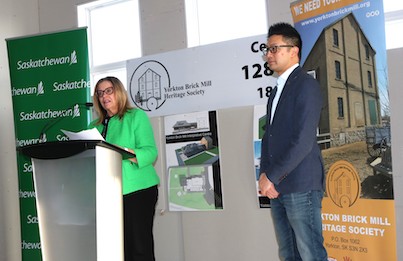
The funding was announced at an event at the mill by Parks, Culture and Sport Minister Alana Ross, last Thursday.
“This is part of our history,” said Ross who also said she personally feels connected to the mill in the sense her grandmother used flour from the facility, it “. . . was her favourite flour. . . and she was a fantastic baker.”
Ross said the mill itself was notable “as the only brick construction mill” left in the province, calling it “an important part of our province’s story.”
Now with the government announcement the interpretive centre can be completed, said Ross, who added the centre will provide varied opportunities in terms of tourism and education once completed.
“This is really about what Saskatchewan is all about,” said Agriculture Minister David Marit also in attendance for the announcement.
Marit noted Yorkton has become known for its value-added processing citing oat milling, canola crushing and meat processing, which really simply follows what the flour mill did when built more than a century ago taking wheat produced in the region, turning it into flour that was then sold across the province and beyond.
The creation of the mill so long ago “is an amazing story” which will now be told, said Marit, who added the interpretive centre will remind how the agriculture industry has grown and why it continues to matter to Saskatchewan.
Yorkton Mayor Aaron Kienle said the announcement was welcome because it will allow a worthwhile project to be completed.
“This is such an exciting project,” he said, having noted the facility “. . . means so much to the community and our region.”
Kienle said for him the mill restoration and the interpretive centre is ultimately about the efforts of the community.
“It’s always been about people . . . willing to do the work to bring it (the mill) back,” he said.
Kienle would later remind that when the Society first broached the idea of saving the mill it was in disrepair and the city quickly agreed to sell it to them for one dollar, and it has been their effort that culminated in the project which will now be completed.
Larry Pearen, president of the Yorkton Brick Mill Heritage Society said the $600,000 was huge, the final step in a sense “for a dedicated group of volunteers” who have spent countless hours getting the project to this point. He said now with the final dollars pledged those volunteers “can look back and see how much was accomplished.”
With funding to finish the project secured they will immediately begin contacting sub-contractors to finish the centre – not including landscaping — which had stalled in terms of completion because funds had run out, Pearen told Yorkton This Week.
If all goes smoothly Pearen said the interpretive centre which will have a final price tag of roughly $3 million would be complete in time to open in June.
When complete Pearen said he sees the potential of the mill and centre “to increase tourism in Yorkton,” and with that will come economic activity.
Once open the Interpretive Centre will be a fully accessible, year-round gathering space where schools, seniors, families, and visitors can learn about the importance of agriculture and Saskatchewan’s rich history.
The Government of Saskatchewan’s $600,000 contribution adds to the $1 million from the Government of Canada, $300,000 from the City of Yorkton, support from the Yorkton Tribal Council and many other local companies, organizations and individuals. Fundraising efforts have been led by the Yorkton Brick Mill Heritage Society.
The Brick Flour Mill is a designated Municipal Heritage Property in the City of Yorkton that operated as a mill for almost a century, from 1890 to 1989. Now a museum run by the Yorkton Brick Mill Heritage Society, it is Western Canada’s only remaining brick-constructed flour mill, symbolizing an important chapter in Saskatchewan’s history. It preserves the stories of early agriculture in the region and the essential role that family farms played in shaping Yorkton’s agri-business sector.